This article was updated on 08/04/20.
Before getting started, be sure that you look into your options. There are several different types of baseboard. This article goes over four of them.
Cutting and installing baseboards is one of the last trim jobs in a typical residential construction or remodeling project. Baseboard is cut with a coping saw or miter saw. In a perfect world, all the inside and outside corners of your walls would be a 90° angle. You could just use a table saw or a miter saw to miter all wood trim, baseboards included.
But alas, it’s not a perfect world and wall corners are rarely a 90° angle. So, almost all baseboard miters will have to be custom cut to get those sought-after professional results. Enter the coping saw. In this article we will take a look at the art of coping baseboards as well as using a miter saw.
Use a Quality Coping Saw
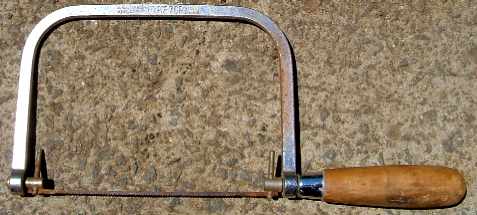
A coping saw
A good-quality coping saw is quite inexpensive; one can be had for under ten dollars at any hardware or home improvement store. The coping saw is intended to cut on the pulling stroke. The teeth are facing the handle, in other words.
This gives you more control over the more precise cuts. But a lot of carpenters like to fit their
blade with teeth pointing away from the saw’s handle so that it cuts on the push stroke instead. Try it
both ways and make up your own mind. Different strokes for different folks, as they used to say.
A Tool and Material List for Coping Baseboards
Coping saw
Compound Miter Saw
Wood files (half round and rat tail)
Sandpaper
Paintable caulk (if you are painting it)
wood putty (if you are going for the natural color)
Finish nails
Hammer and nail set; or a nailer (I like an airless nail gun)
Different Kinds of Miters to Cope
There are basically three places where you’ll be mitering the baseboards. First,there’s are the inside corners where two walls intersect; second, you have the outside corners where the wall changes direction or you have a case opening.
The third place to miter cut is on straight runs where you run out of one board and must start with a new one. This must be mitered at a 45 degree angle and is called a scarf joint; it is bad form to simply butt two lengths together.
Occasionally, due to the architecture of the home, you may have some oddly angled corners. This is where your newly-acquired coping skill will pay off.
Cut the Miter Joint with a Coping Saw
Your first step in the coping process is to establish your cutting line. What you are looking for is a 45 degree angle to give you a good bevel. Although as stated before, this will vary since no wall is perfect.
Begin with a forty-five degree angle. Test fit your cope on the adjacent trim. Sometimes your cope will be an exact fit right off the bat. But others will need a few minutes filing and sanding to achieve a snug fit.
If your joint is nearly fitting, you will just need to sand down
the odd spots using sandpaper. To take off a larger amount of wood, use your wood files. It may take
several passes but don’t worry, your coping skills will soon improve (pun intended).
Cutting Baseboard with a Miter Saw
Let’s consider using a miter saw for cutting and installing baseboards. This is the way to
go when your walls are accurately framed and sheetrocked. Modern saws are very precise. The better
ones will cost a bit more, but you’re buying accuracy and portability.
Some use a laser beam for precision.
Some have additional functionality, such as DeWalt’s new DW717 heavy duty 10 inch Double-Bevel Sliding Compound Miter Saw. It’s arguably the best model on the market today. Where you buy your tools makes a difference. Always use a reputable dealer that specializes in woodworking, such as Rockler Woodworking and Hardware.
Nail Your Baseboard to the Wall
When you go to nail the baseboard up you will not always have a handy stud, but that’s alright; remember that you can nail to the bottom plate of the
wood framing. Also, avoid nailing through the corner bead because you might blast off bits of sheetrock compound.
You can use finish nails with a nail set or a finish nail gun. I prefer and use a Ryobi battery-operated nail gun. It makes it easy to nail something so low, sets the nail head automatically, and doesn’t require dragging an air compressor around.
Finishing the Trim Job
Once you've got all the baseboard installed, use the caulk or putty to put the finishing touches on the job. Done properly, the joints will be virtually imperceptible.
Homemade Wood Putty Recipe
This is a little trick I love to use when I’m going for a natural wood finish rather than a paint job. Rather than use store-bought putty and try to match the wood’s natural color, I save the fine sawdust from when I was making my miter cuts or crosscuts.
Then I make a putty using the sawdust and Elmer’s white glue (not yellow carpenter’s glue). The glue dries clear and I’m left with the wood’s own color. It’s the perfect match after you're done cutting and installing baseboards.
Did you find this article helpful? Thanks for supporting this free site with a small donation! We rely on our readers rather than a paywall to keep the lights on.
About the Author:
Kelly R. Smith was a commercial carpenter for 20 years before returning to night school at the University of Houston where he earned a Bachelor’s Degree in Computer Science. After working at NASA for a few years, he went on to develop software for the transportation and financial and energy trading industries. He has been writing, in one capacity or another, since he could hold a pencil. As a freelance writer now, he specializes in producing articles and blog content for a variety of clients. His personal blog is at I Can Fix Up My Home Blog where he muses on many different topics.

















 Some have additional functionality, such as DeWalt’s new DW717 heavy duty 10 inch Double-Bevel Sliding Compound Miter Saw. It’s arguably the best model on the market today. Where you buy your tools makes a difference. Always use a reputable dealer that specializes in woodworking, such as Rockler Woodworking and Hardware.

 Kelly R. Smith was a commercial carpenter for 20 years before returning to night school at the University of Houston where he earned a Bachelor’s Degree in Computer Science. After working at NASA for a few years, he went on to develop software for the transportation and financial and energy trading industries. He has been writing, in one capacity or another, since he could hold a pencil. As a freelance writer now, he specializes in producing articles and blog content for a variety of clients. His personal blog is at